Sic Bo rules and house edge
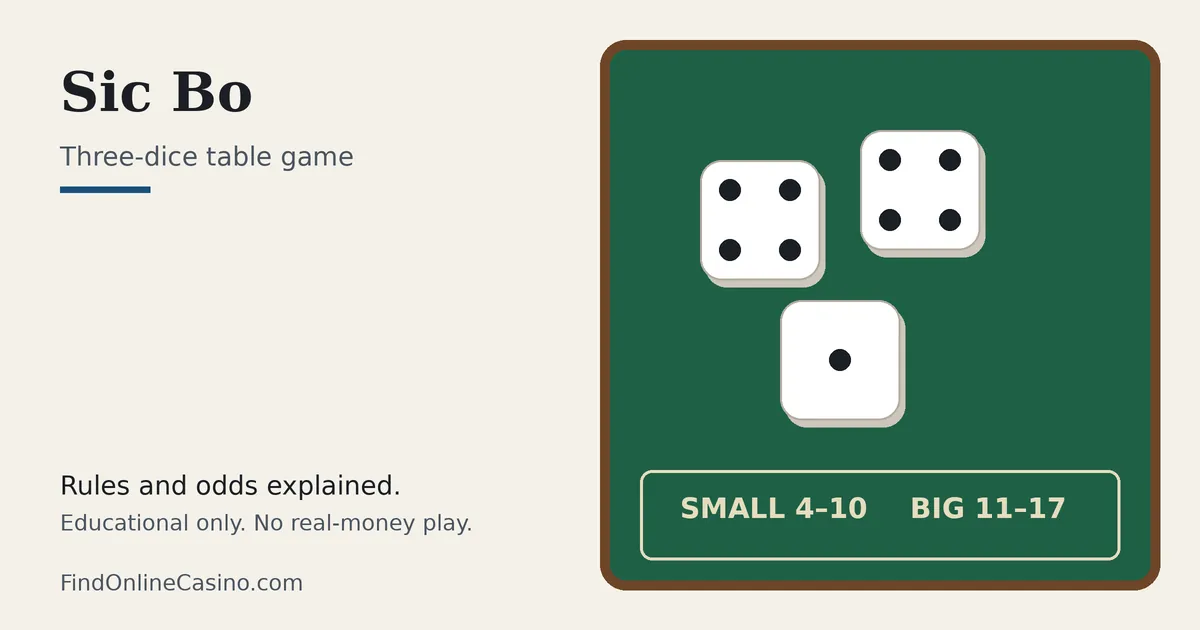
Sic Bo is a dice game of Chinese origin. Three dice are shaken in a covered container or by a machine, and players bet on the result. The table layout offers many bets, from simple totals to specific combinations, each with its own payout.
Big and Small
The simplest bets are Small (a total of 4 to 10) and Big (a total of 11 to 17), each paying even money. Both lose if the three dice show the same number (a triple).
Working out the edge
Three dice can land in 6 × 6 × 6 = 216 equally likely ways. Totals of 4 to 10 cover 108 of those ways. Two of the triples, 2-2-2 and 3-3-3, fall in that range and lose, leaving 105 winning ways for Small. Big is the mirror image. An even-money bet that wins 105 times out of 216 has a house edge of (216 − 2 × 10⁵) ÷ 216 = 6 ÷ 216, about 2.78 percent.
Other bets
Totals, doubles, specific triples, and single-number bets each have their own pay tables, and those pay tables differ between casinos. Many carry a much higher edge than Big or Small. Check the posted payouts; the Wizard of Odds page cited below compares common versions.
Play safely, or not at all
This guide is educational. We do not offer games, accept bets, or link to casinos. In the U.S. states that currently license online casinos, you must be at least 21 and physically located in that state. Every casino game on this page has a built-in house advantage or a fee, so treat any money you play with as money you may lose. Set a budget and a time limit before you start. If gambling is causing harm, call or text the National Problem Gambling Helpline at 1-800-MY-RESET (1-800-697-3738) or see our responsible gambling help page.
Frequently asked questions
Why do Big and Small lose on triples?
That rule is the source of the house edge on those bets.
How many outcomes do three dice have?
216 equally likely outcomes (6 × 6 × 6).
Sources
See also: all game guides, where online casinos are legal, and responsible gambling help.